Racing with a Disability
Updated: Mar 9
I've decided to share my experience of becoming a racing driver and what it’s taken to get there living with disability.
Despite being partially disabled (see my blog on “Who is Julian McBride?”) I wanted to find a way to race as naturally as possible and to race on equal terms. This means I have to be judged on equal terms which is quite hard when you have no fine throttle control, made even challenging in the rain, nor have any idea where your feet are (because you can neither feel nor move them!).
There are plenty of disabled racing drivers out there, each with their own issues and challenges to deal with in order to race, Billy Monger being probably the most well known, along with Nicolas Hamilton. Lesser known to non-racers but very widely known in the racing fraternity, another.
This is my situation - I suffered a spinal injury in 2011. Although I can now walk I do so with aids (foot supports and walking sticks most of the time)
I can't feel nor can I move my right foot.
I can barely feel my left foot and have very little power in it; I can’t push my foot forward / down and can only pull it up.
My right leg is weak and lacking feeling - almost no feeling from the knee-down and diminished feeling above the knee with significantly reduced power in my thigh. On a scale of 1-5 (5 being the most power my leg ever had when I was strong, fit and healthy) I judge mine to be a “2”. My left thigh is still 5/5.
I have constant nerve pain - that horrible feeling when you bang your funny bone, is how both legs feel 100% of the time; add to this a constant possibility of random electric shocks that can affect just my foot or my whole leg and the drain on one mentally and physically.
I was offered a number of drugs to help deal with the nerve pain. Drugs such as Gabapentin, Pregabalin, Amitriptyline to name but three. I decided that getting used to the pain was better than pumping my body full of drugs that could affect my ability to drive and function. “Getting used to pain” however is a strange statement. You “live” with pain but never really get used to it. When it’s with you 100% of the time it can be very draining, both physically and mentally. I found the best way to deal with the pain is through exercise. The more I exercise, the more endorphins my body produces and so a much more natural way of coping with pain. It also keeps me fit, something I used to enjoy anyway. To this end I’m lucky that I always did enjoy being fit.
Because I can't feel nor move my right foot, it has to be used for the throttle only, which means I have to left-foot-brake. I am therefore unable to drive normal, manual cars with a foot clutch. This as it turns out, is in fact a bonus when it comes to racing – left-foot-braking which is hard to do for most people (if you’ve ever tried it in a normal car when you’re not used to it, you generally end up with your face pressed against the windscreen . . or would do without a seat-belt!! Most people are unused to the pressure needed to left-foot-brake. For me it was completely natural and I’m lucky that I didn’t have to learn this.
Left-foot-braking however isn’t just a case of smashing the brake pedal with your left foot. You still need to “feel” the brake pressure and what happening to the brakes when you apply and release the brake pedal. This is something I can’t do or at least can’t do using my foot; I have to use my whole leg, just as I do with the throttle.
Learning to apply the throttle gently when you can only move your whole leg is really a challenge, the difficulty being when you accelerate out of corners in a controlled way. If you apply too much throttle too quickly or too soon, or even too late, you can spin, miss your exit and end up wide, miss your turn in point and therefore your apex, again ended up wide or spinning. Without subtle throttle control, you’re already significantly disadvantaged and behind the pace.
1st race car modifications (BMW E46 M3, S54 normally aspirate 3.2L power unit)
Throttle pedal - Aluminium plate with a ramped on the right side attached to the throttle pedal so that my foot didn’t slip off the pedal and down behind it without me knowing.
Brake pedal – a very wide plat fixed onto the brake pedal so there was less risk of me missing the brake when I wanted to press it.
Braking - Amber light fitted in front of the instrument cluster so I could see when my foot was on the brake pedal.
Throttle - Row of red LEDs stuck on top of the dash in my line of sight so I could see how much I was pressing the throttle. This was important was I often found my right leg would “fall” onto the throttle under braking due to inertia, and I was not aware of it. This resulted in me understeering on corners as I wasn’t able to slow the car down, ultimately then braking earlier to compensate. This took a lot of work, both awareness and exercise to strengthen the muscles to pull my leg deliberately aware from the throttle under braking. For a normal, able-bodied person do this is easy. You don’t even think about it. For me it had to be a very conscious thing which took time to develop and train myself for it to become unconscious. It requires a lot more physical effort and so over the course of a 2-hour race, takes a lot of effort and has the effect of impacting your consistency. I had to train and work hard to cope with this.
The challenge with my disability is it’s not ideal when you are looking for small margins. Even with the LEDs it was hard to be cognisant of those while hurtling round a race track when you're a novice. Just getting used to handling the car was enough to begin with; I talk about cognitive overload in one of my videos; I struggled hugely with this at first. I learned how to rear-wheel steer early on which isn’t the fastest way around a race track but it does teach you some useful skills. Learning what a car feels like when sliding at high speed, both intentionally and unintentionally is a fundamental part of learning to race. You put the car through more stresses and strains, and do things with it that you would never do with a road car, and learning all this was key.
I just accepted this was how I had to drive. Until 2018 when I had coaching from a top, professional racing driver who has raced just about everything but for Formula 1.
We worked on braking technique at the same time as lifting my right leg away from the throttle, really focusing on that instead of just accepting it as a disability. It transformed my driving beyond all recognition.
2nd race car modifications (BMW E46 M3, S55 Twin Turbo 3.0L power unit)
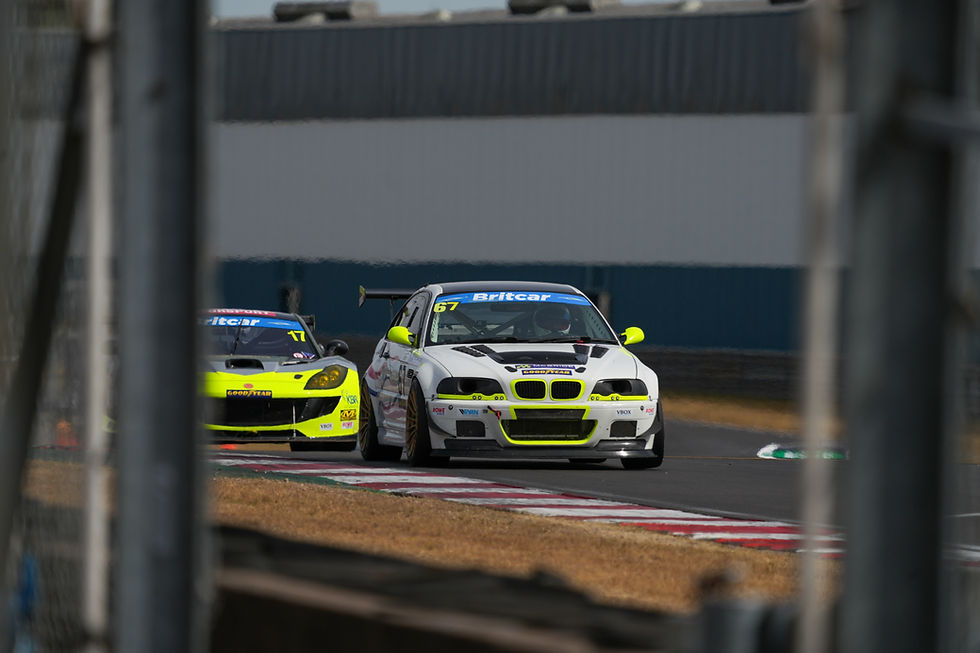
My second car, built in 2021 due to me having learned to out-perform my old car and wanting something that would take me forward into higher level racing at some point, was another BMW M3 but this time with a twin turbo engine.
This car was built from the ground up starting with an empty shell so very little about it is in fact BMW – the engine, the chassis . . . and that’s about it
Because my original car had the original servo assistance when braking, it was also hard to brake in the right way with the car deciding to apply more brake pressure than you actually wanted. We therefore had a pedal box fitted and that meant I had to use my left leg to apply the brakes as hard as possible.
Extended brake pedal to get extra leverage
Platform to raise my left foot to allow me to brake with my heel as opposed to the ball of my foot – I can’t push my foot down
Dividing wall between left foot and right foot to prevent my left foot from accidentally stamping on the throttle when braking (yes, this happened . . . not ideal!)
Curved and sloped side plate on the right of the throttle pedal, pedal smoot with no grip. This is to allow me to pull my foot off the throttle but when pressing it again, making sure that if my foot is slightly to one side it does make contact with the pedal. The side lip is also sloped to prevent my foot from pressing on top of the end plate and then subsequently slipping back onto the pedal correctly too quickly, thereby causing the throttle to jerk harder which, when exiting a corner is the last thing you want to happed as it will unsettle the car and likely result in a spin (in a rear wheel drive car like this one)
Hand clutch – because I had a proper sequential gearbox using dog rings, I still need a clutch to start and stop. As endurance racing starts are all rolling, I don’t have to worry about how to control the clutch from standing still. It is still however a challenge as getting a good start in the pits after a pit-stop, if you stall the car you lose vital seconds
Racing
Dealing with all the above modifications and learning to train my body to handle things a certain way, to do things slightly differently, has all been part of the fun and experience of overcoming a disability. Whilst my disability is not as bad as others, it does limit me.
Other teams such as Team Brit have done wonders for showcasing disabled drivers in motorsport and the hand control technology they have developed has been a game changer for some.
For me however, I wanted to do things that work for me specifically and going through the pain of learning, adapting and overcoming obstacles and challenges has put me in a fantastic position to help others. I’ve learned by doing, by making many mistakes, through crashes and offs that I’ve had, to component failure under load, how I’ve treated my car, or should I say the stresses and strains my cars go through in dealing with me as a disabled driver.
I’ve learned and trained my body to react and behave differently, to be finer and more nuanced with the controls and have found ways to overcome things like spinning up the turbos too quickly in the wet, resulting several times in me spinning. I’ve adapted my driving style to compensate.
The other challenges of racing with disability has been the venues themselves. I’m a member of the Motorsport UK Disability and Accessibility sub-committee and recently was involved in a project to highlight and guide circuits on how to make it easier for anyone with a disability to be involved, whether as a driver, spectator, marshal, press or other.
Here I will only share my experiences as a driver, those being related mostly to the challenges of getting round the venue, wash / shower facilities, toilets.
Many circuits provide adequate facilities for normal, able-bodied people but as a driver, if you’re staying at the circuit and don’t have your own camper with shower and toilet, it can be really hard to shower safely and cleanly. Some facilities don’t provide seating in the shower if you are unable to stand. Most circuits don’t provide showers specifically for disabled / wheel-chair bound drivers. Even if you’re not wheel-chair bound but cannot stand safely on your own, not having a way of cleaning yourself while holding on to a handle, or with a disabled seat has proven tricky and resulted in my having fallen a couple of times.
I decided that complaining is not the right approach, instead electing to become part of the disability sub-committee and working pro-actively and constructively in the background to help enable improvements in such things.
The more I remain involved both as a racer and committee member the more impact I can have for the better, and hopefully to improve things for other disabled drivers that want to get involved.
Want to know more? Contact me.